
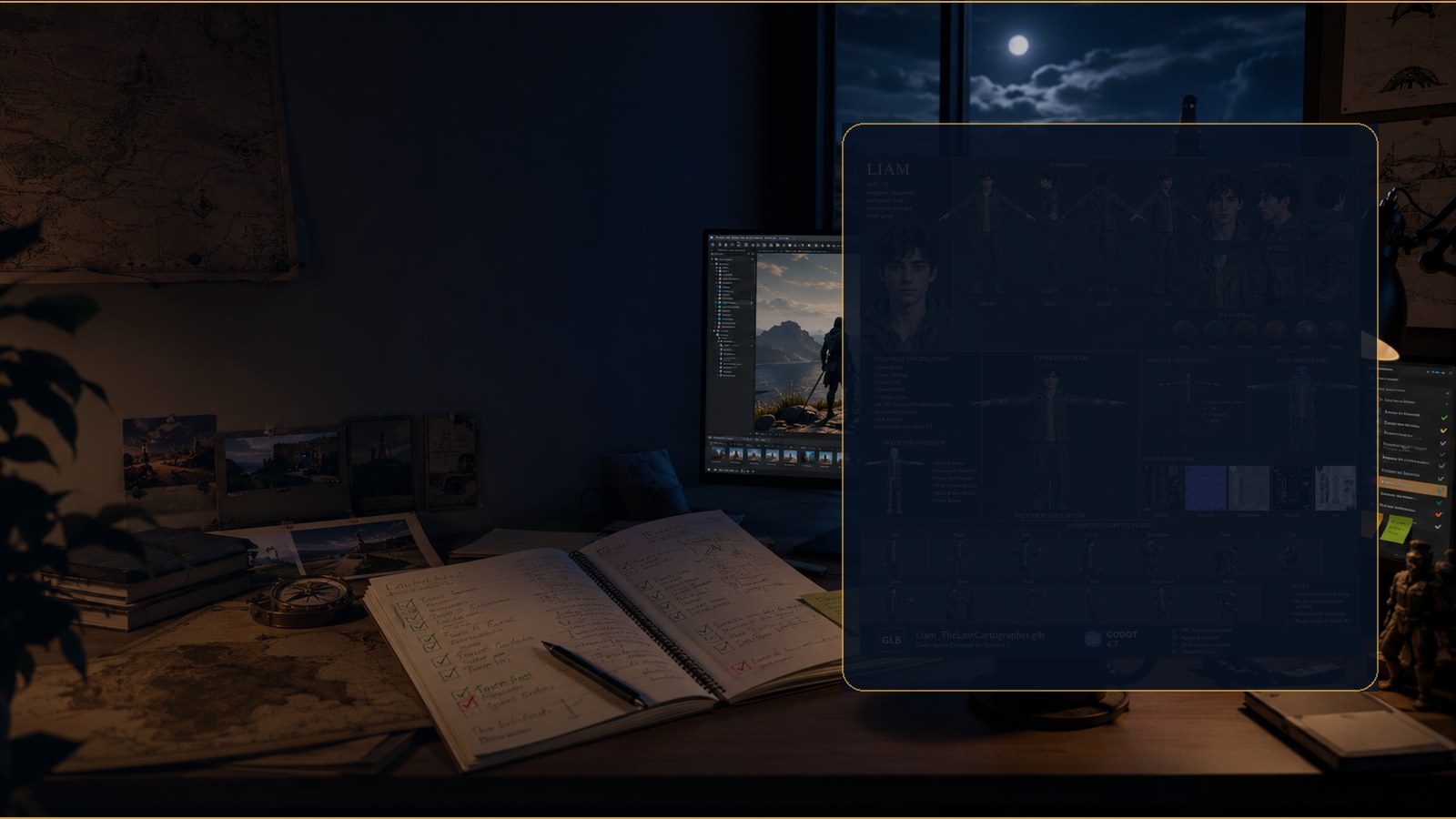
The next major visual upgrade for The Last Cartographer is also one of the riskiest: moving the main cast and NPC pipeline toward GLB characters.
Changing the character pipeline touches almost everything, so I am building the adapter before replacing the cast.
Sprites got the project far enough to prove the rooms, navigation, conversations and interaction systems. But I want the characters to sit more naturally inside the 2.5D environments, with stronger walk cycles, better facing, more expressive conversations and a consistent set of actions across the game.
I am not simply dropping a 3D model into the project and hoping for the best. The renderer foundation needs rules. Models need a clean humanoid skeleton, skinned mesh, embedded PBR textures, feet-grounded origin and a consistent forward direction. The rest pose needs to be predictable. Animation clips need clear names such as Idle, Walk, Talk, Look, Examine, Take, Use, Give, Open, Push, Pull, Surprised and Hurt.
Walk is particularly important because it must be in-place. The game already owns movement through its navigation system. If the animation also moves the model forward, the character will drift, slide or fight the pathing code.
I am building an animation adapter so game logic can ask for an action without caring whether the visual implementation came from the old sprite system or a GLB model. That separation is important because I do not want the character upgrade to force a rewrite of every puzzle and conversation.
The Dev Workshop is part of this work too. I want an inspection mode where I can load a GLB, verify orientation and scale, see available animation clips, test them, and identify the model being used in a room.
The other goal is variety. NPCs should not all walk, pause and look around with identical timing. The new pipeline should make it easier to give different characters different movement personalities while keeping the underlying system manageable.
This is foundation work rather than a flashy finished feature, but it is the kind of foundation that should improve almost every scene once the cast begins moving through it.